
- Restaurants
- May 23, 2026
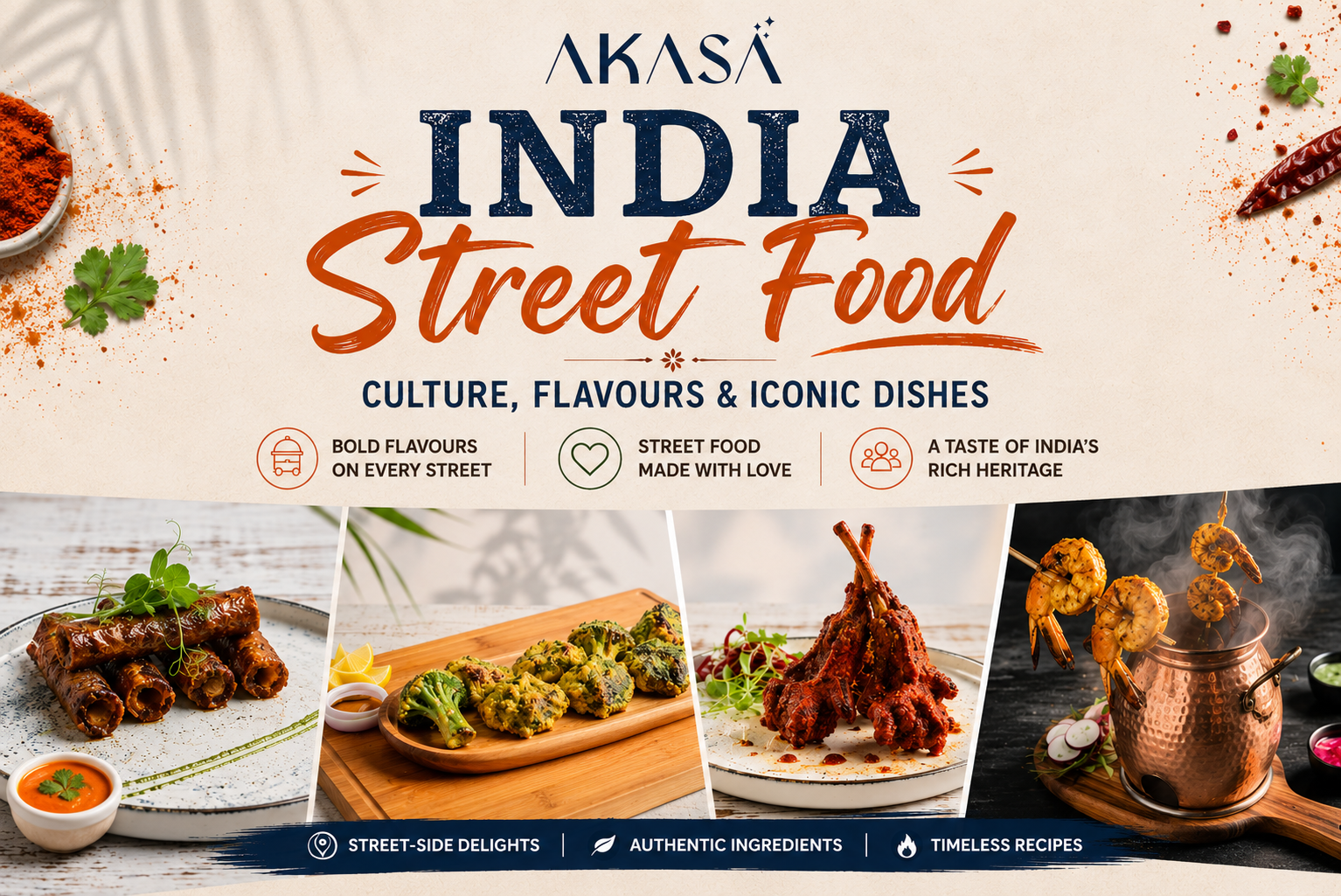
Nobody goes to India planning to eat street food. It just happens. You step out of a hotel, you smell something, and ten minutes later you are standing at a roadside stall with oil on your fingers wondering how a dish this good costs almost nothing.
That is the thing about india street food — it catches you off guard every time.
There is no curated experience here. No tasting notes, no mood lighting. Just a vendor who has made the same dish five hundred times this week alone, and somehow it keeps getting better. The spices are not measured. The cooking is done by feel. And yet the result is consistently more interesting than most restaurant meals people pay ten times more for.
Singapore food lovers have a particular relationship with indian food. The cultural familiarity runs deep here — Indian communities have been cooking, adapting, and preserving these recipes across generations in this city. So when we talk about india street food at Akasa, we are talking about something people here already have a connection to, whether they realise it or not.
This guide goes through the whole picture — the dishes, the regions, the cities, the culture, and what all of it means for someone eating Indian food in Singapore today.
What Makes India Street Food Culturally Unique?
A Food Culture Rooted in Everyday Life
Street food in India is not positioned as an experience. Nobody markets it. There are no signs saying “authentic” outside a good stall — the queue does that job instead.
These stalls exist because people need to eat affordably and quickly. Office workers grab something on the way in. Kids stop on the way home from school. A retired man sits on a plastic stool at the same corner he has been visiting for thirty years. India street food feeds real daily life, and that is exactly why it tastes the way it does — unperformed, unfussy, and completely honest.
Regional Diversity Across States and Cities
Twenty-eight states. Hundreds of distinct food cultures. The gap between what gets eaten on the streets of Chennai versus what gets eaten on the streets of Lucknow is not a matter of small variations — it is an almost entirely different food vocabulary.
The cooking fat changes. The staple grain changes. The spice combinations shift dramatically. Even the way food is handed to you is different from one place to the next. This is why india street food never exhausts itself as a subject — there is always a region, a city, a neighbourhood you have not gotten to yet.
The Role of Spices, Chutneys and Cooking Styles
The chutney is not a garnish. Anyone who thinks the tamarind chutney on pani puri is optional has never actually eaten pani puri properly. That chutney is the dish. Remove it and the whole thing falls apart.
Spicing in india street food happens in stages. Whole spices go into the hot oil first. Ground masalas follow once the base is ready. Fresh aromatics — coriander, ginger, green chilli — come in at the end. This is not a technique people read about. It is just how it is done, absorbed from watching and repeating, passed between cooks for generations without ever being formally written down.
Street Food as a Social Experience in India
You rarely eat alone at an Indian street stall. People argue about whose version is better. A stranger next to you will tell you, unprompted, that the pani puri at the other stall is actually superior and you should go there instead. Plates get shared without asking. Everyone is watching the vendor work.
The food is part of it. But honestly, so is everything around the food.
Most Iconic India Street Food Dishes You Must Know
Pani Puri (Golgappa) – India’s Most Loved Bite
From Delhi originally, though every North Indian state has its own version and a strong opinion about why theirs is the correct one.
The drill: hollow fried shell, spiced potato and chickpea filling, plunged into ice-cold tamarind water, eaten in one bite before the shell softens. Everything hits at once — sour, spicy, earthy, cold, crunchy. The whole process takes four seconds. No india street food experience produces that kind of immediate sensory impact. Nothing else comes close.
Vada Pav – Mumbai’s Everyday Street Burger
Fried potato fritter in a soft bread roll. Dry garlic chutney pressed into the bread. That is it. No secret technique, no elaborate preparation. Mumbai turned this simple combination into its defining food identity and it deserved to. It costs almost nothing, it fills you up, and it tastes better eaten fast outside a crowded train station than most things you will order at dinner.
Pav Bhaji – Buttered Comfort Food
Mixed vegetables mashed and cooked on a large flat griddle all day, getting richer and darker as the hours go on, finished with a serious amount of butter. Served with bread rolls toasted in more butter on the same griddle. Pav bhaji does not pretend to be subtle. It is just very, very satisfying and that is enough.
Chole Bhature – North India’s Heavy Favourite
Dark chickpea curry, tangy and deeply spiced, paired with puffed fried bread. This is Sunday morning food. Holiday food. Eat-it-then-lie-down food. Nobody orders chole bhature and then has a productive afternoon. It is a commitment and it is worth it.
Masala Dosa – South India’s Crispy Classic
Fermented rice batter cooked thin and flat until the edges go almost black. Potato filling inside — spiced with mustard seeds, curry leaves, turmeric. Sambar and coconut chutney on the side. The texture contrast between that brittle shell and the soft filling is one of the best things about india street food technically. You hear it before you taste it.
Kathi Rolls – Kolkata’s Portable Meal
Egg-coated flatbread, cooked on a griddle, filled with spiced paneer or meat, raw onion, green chutney, rolled up tight. Kolkata built this format. You eat it walking. The ratio of filling to bread at a good stall is generous enough that it holds you for hours.
Samosa – India’s Universal Snack
Every region makes samosas. Every region argues theirs is better. The shell thickness varies, the spice level varies, the size varies from tiny to enormous. But the core idea — crispy pastry, spiced potato filling — stays consistent. The samosa is the one item in india street food that crosses every regional and cultural boundary without debate.
Bhel Puri – Tangy Crunch Explosion
Puffed rice, thin sev, raw onion, tomato, raw mango, coriander, tamarind and green chutney, tossed together by hand right in front of you. Light, crunchy, sour, a little sweet. Mumbai beach vendors have been making this the same way for decades. There is genuinely nothing that needs improving.
Momos – North-East Street Favourite
Steamed dumplings, thin-skinned, filled with spiced vegetables or meat, served with a red chilli chutney that is actually hot — not decoratively hot, actually hot. Momos came from the Himalayan North-East and made their way into the mainstream india street food conversation fully on merit. The filling is dense. The chutney is not optional.
Jalebi – Sweet Street Indulgence
Fermented batter piped in spirals, fried until crisp, dropped straight into sugar syrup while hot. You eat them warm. The outside snaps, the inside is chewy and syrup-soaked. Jalebi shows up at nearly every india street food market in the country. It is usually eaten alongside something salty as a counterpoint, which is the right instinct.
India Street Food by Region
North India – Rich, Spicy and Chaat-Focused Culture
Chaat is the backbone of North Indian street food. Tamarind, yoghurt, fried dough, spiced potato — these four things in various combinations produce most of the menu. Mughal influence added kebabs and slow-cooked gravies. Dairy appears constantly. The food is filling, sometimes very spicy, and rarely light.
West India – Fast, Fried and Bold Flavours
Maharashtra does not have time to sit down. Vada pav and pav bhaji are built for people with fifteen minutes and a hunger to deal with. Gujarat adds a different dimension — fermented, steamed snacks like dhokla and khandvi that run on completely different culinary logic. West Indian india street food is designed around speed without sacrificing character.
South India – Rice-Based Comfort Street Foods
Dosa, idli, uttapam, medu vada — rice and lentil based, fermented, mostly vegetarian. Lighter than the North, more sour from fermentation, coconut in almost every chutney. The heat in South Indian india street food builds slower than in Northern dishes. It sneaks up on you.
East India – Sweet-Savoury Balanced Cuisine
Kolkata puts sweetness into things that should technically be savoury and somehow makes it work every time. Fish cutlets next to syrup-soaked sweets at the same stall. The kathi roll alongside mishti doi. Everything here balances contrast — it is built into the food culture in a way that does not exist anywhere else in India.
North-East India – Hidden Himalayan Influences
Momos, thukpa, bamboo shoot preparations, fermented ingredients from tribal cooking traditions that predate most documented recipes. North-East India barely gets mentioned in mainstream india street food conversations and that is a significant oversight. The flavour profiles here are unlike anything else in the country.
India Street Food Experience for Singapore Food Lovers
Why Indian Flavours Are Popular in Singapore
The Indian community in Singapore has kept its culinary traditions alive across multiple generations. The spice references, the chutney styles, the specific regional dishes — these exist here already, in home kitchens and in community spaces, not just in restaurants. So india street food does not arrive in Singapore as something foreign. For many people here, it arrives as something familiar seen from a new angle.
For anyone building their understanding of what Indian food actually is, exploring authentic Indian food in Singapore gives you a foundation to work from.
Indian Street Food Inspired Menus in Singapore
The restaurants in Singapore doing this well are not trying to reproduce a street stall inside a dining room. The conditions are different, the operational context is different. What works is preserving the flavour reasoning — the spice sequencing, the chutney logic, the texture decisions. Those elements translate across any environment when handled with knowledge.
Fusion Adaptations for Local Palates
Spice levels shift. Some ingredients substitute based on what is available and what works for local preferences. When this is done with understanding, it is not dilution — it is how food has always moved between cultures without losing its identity.
Akasa handles this with care. The point is never to produce a simplified version. The point is to keep the flavour logic intact while adapting the format intelligently.
Demand for Authentic Indian Taste Experiences
Interest in Indian fine dining in Singapore has grown noticeably and it is not just about the food. People want the context. They want to understand regional differences, cooking traditions, why certain combinations exist. India street food culture is where a lot of that story begins.
Akasa takes that context seriously and puts it into what goes on the plate.
What Defines Authentic India Street Food Taste?
Spice Layering Techniques
Whole spices first — cumin seeds in hot oil, mustard seeds popping. Ground spices next, once the base is ready. Fresh ingredients last, added quickly so they retain their brightness. This is the sequence that creates depth. Single-stage spicing produces flat food. Authentic india street food is never flat.
Fresh Preparation at Every Stall
Good stalls make small batches constantly rather than one large batch that sits. At a place serving 200 people in two hours, nothing has time to sit anyway. The freshness is not a selling point — it is just the unavoidable result of how a busy street stall operates.
Use of Chutneys and Regional Masalas
Chaat masala in Delhi. Sambar powder in Chennai. Pav bhaji masala on the west coast. These blends are not interchangeable and you can taste the difference immediately. The chutneys — green, tamarind, coconut — each complete a different dish differently. They are built into the dish, not added to it.
Texture Balance
Crispy sev on soft bhel. Brittle dosa shell around tender filling. The snap of a jalebi giving way to a chewy syrup-soaked centre. Texture contrast is as deliberate in india street food as spice selection. The best dishes always have at least two opposing textures working against each other. That tension is part of what makes them satisfying.
Hygiene and Safety Awareness in Street Food Culture
How Vendors Maintain Fresh Preparation Practices
Serious vendors run tight prep routines. Ingredients are ready before service starts. Oil temperature is monitored through the shift. Everything is cooked and handed over immediately — at a stall with a constant queue, there is physically no room for food to sit around.
What Makes Street Food Safe in Local Context
High cooking temperatures handle most bacterial concerns. Fast service means minimal time between cooking and eating. The practical guide most experienced travellers use: stalls with a consistent queue are reliable. Stalls with food sitting uncovered and no customers are not. The queue is the signal, not the signage.
Common Misconceptions About Hygiene
Assuming that street food is inherently unsafe is not a food safety position — it is a comfort position. Many long-running street stalls maintain cleaner prep areas than they get credit for. A vendor who has fed the same neighbourhood for twenty years has earned that trust through consistent, safe food. The track record is visible if you pay attention.
Tips for First-Time Tryers
Hot, freshly cooked food is your starting point. Skip raw cut fruit at stalls without cold storage. Choose busy stalls over quiet ones. And get your recommendations from people who actually live in the area — locals will not send you somewhere bad, and they will not recommend somewhere just because it photographs well.
Common Mistakes People Make While Exploring Indian Street Food
Sticking Only to Tourist Spots
Tourist-facing stalls charge more and often pull back on spice or authenticity to appeal to the broadest possible audience. The food you actually want is usually a few streets in the opposite direction from wherever the tour groups are pointing.
Avoiding Local Recommendations
Food apps rank by review volume, not accuracy. Travel blogs follow each other in circles. The person who actually knows where to eat in any Indian city is someone who lives there and eats street food regularly. Ask them. They will not mislead you.
Not Trying Regional Specialties
Going to Hyderabad and eating butter chicken is like visiting Japan and ordering pasta. The regional specialty exists because it is the best expression of what that place knows how to cook. Order the thing the city is known for. That is the whole point of being there.
Ignoring Spice Diversity
Spicy in one Indian city is a different biological experience from spicy in another. Do not assume your tolerance from one regional meal applies to the next. Ask the vendor. Taste a small amount first. India street food rewards the people who approach it with genuine curiosity rather than fixed expectations.
How to Experience Indian Street Food Like a Local
Evening Street Food Walks
The 6pm to 10pm window is when most india street food stalls are at full speed. Freshest food, most energy, biggest variety. Plan at least one evening per visit specifically around walking and eating rather than sitting in a restaurant. It will be the meal you remember most.
Market-Based Food Exploration
Local weekly markets are not built for visitors. The prices are honest, the food is real, and the vendors are not performing for an audience. These are the best places to find things that do not appear anywhere online — regional preparations that exist because the neighbourhood wants them, not because they are photogenic.
Festival Street Food Culture
Major Indian festivals bring out food that does not exist on regular days. Vendors prepare special items for Diwali, Holi, Pongal, Eid. If you are in India or at an Indian food event in Singapore during festival season, the depth of the india street food experience doubles. Some of the best things you will ever eat are only available for one week a year.
Sampling Multiple Small Portions
One large dish gives you one data point. Five small things give you five. India street food is built around the idea of trying multiple things — a pani puri here, a piece of dosa there, some bhel, a samosa, a jalebi at the end. That is how the culture actually works and it is a much better way to understand a city’s food than committing to one big plate.
India Street Food vs Restaurant Dining
Authenticity Comparison
Street food reflects what people eat on a Tuesday for no particular reason. Restaurant food reflects what people eat when they are making an effort. Both are valid. But the street version carries more of the original character — the practical cooking, the regional specificity, the lack of audience performance.
Price vs Experience
You can eat extraordinarily well from india street food for almost nothing. A restaurant version of the same dish often costs many times more and is not necessarily better — just more controlled. The open-fire cooking, the immediacy, the physical context of eating standing up — these are part of the flavour in a way that is hard to explain and impossible to charge for.
Cooking Style Differences
A dosa made over an open flame on a well-seasoned iron griddle has char and crispness that a restaurant kitchen environment rarely reproduces. High heat and flat iron cooking produce results that differ from enclosed kitchen setups. Not categorically better — but different in ways that matter if you care about texture.
Emotional and Cultural Value
A plate of pani puri eaten at a busy stall in Old Delhi stays with you for years. The flavour does not fade from memory the way most restaurant meals do. India street food carries emotional weight that the dining room format cannot manufacture. That is its real value and no amount of presentation or plating changes the equation.
Why India Street Food Has Global Influence
Migration of Flavours Worldwide
Indian communities settled across Southeast Asia, East Africa, the Caribbean, the UK, and beyond — and they cooked. They kept making what they knew, adapted it for available ingredients, and passed it to the next generation. India street food flavours now exist in cities that have never hosted an Indian street stall, carried there entirely by people who needed to eat what felt familiar.
Popularity in Southeast Asia
Singapore has one of the most developed Indian food cultures outside of India itself. The community here preserved recipes across generations with genuine fidelity. For anyone exploring Indian cuisine in Singapore properly, the street food traditions embedded in what local restaurants serve are unmistakable once you know what to look for.
Fusion Food Trends in Global Cities
Fine dining restaurants in New York, Tokyo, and London are referencing india street food seriously. Tamarind glazes, chaat-inspired flavour structures, tandoor techniques applied to non-traditional proteins — the flavour logic of Indian street cooking translates into contemporary kitchens when handled by someone who actually understands it.
Cultural Identity Through Food Export
Every pani puri served in Singapore carries something real from where it came from. Food is one of the few cultural exports that cannot be faked at the point of consumption — either the flavour is right or it is not. India street food travels well because it is built on genuine technique and genuine tradition, not on trend.
Conclusion
India street food is not a food category. It is a cultural system — regional, historical, community-driven, and constantly evolving in small ways while staying fundamentally the same in the ways that matter.
From Delhi’s chaat lanes to Kolkata’s roll corners to Chennai’s morning dosa stalls, every city adds something that belongs specifically to it. You cannot fully understand one by studying another. The diversity is the point.
For people eating Indian food in Singapore, engaging with street food culture as a framework changes what you taste and how you think about it. The spice choices make more sense. The regional differences become readable. The dishes stop being dishes and start being places.
If you are looking for an Indian restaurant in Singapore where the food actually comes from somewhere real, Akasa is worth your time. Book a table, come hungry, and bring some genuine curiosity — that combination works every time.
Frequently Asked Questions
Pani puri is the answer most people from North India give without hesitation. In the South, masala dosa holds the same position. Both are right in their own geography. If you are starting from zero, pani puri first — it is the most distinctly Indian single eating experience there is.
Delhi and Mumbai get mentioned most, and neither is a wrong answer. Delhi for chaat depth and Old City heritage. Mumbai for variety and relentless accessibility. Kolkata and Hyderabad have genuinely strong cases that do not get made loudly enough.
Yes, at the right stalls. Hot, freshly cooked food from a busy vendor is reliably safe. The queue tells you what you need to know. Quiet stalls with uncovered food sitting out are a different story.
The spice layering, the chutney specificity, the texture contrast, and the scale of regional diversity. No single description covers all of india street food because the country’s food culture is too varied for one summary to hold.
Pani puri, bhel puri, and samosas are consistently among the least expensive options. In most Indian cities you can eat genuinely well from a street stall for almost nothing by any international standard.
Yes. Little India has hawker stalls and restaurants carrying Indian street food classics. Several restaurants also offer thoughtful interpretations of street food dishes in a seated setting. Akasa draws from these traditions directly — the full menu and reservation details are on the Akasa website.
The flavours are strong enough to be memorable immediately and complex enough to reward more attention over time. That combination — accessible on first encounter, deeper on return — is rare and it is why india street food travels so successfully.
Samosa, pani puri, bhel puri, vada pav, masala dosa, and kathi rolls. Those six cover enough regional ground and flavour variety to give anyone a real introduction to what india street food is actually about.
The range is genuinely wide. Some dishes are not hot at all. Others are aggressively spiced. Most vendors will tell you honestly if you ask before ordering. Do not assume — the variation between regions and even between stalls on the same street is significant.
Evening is the practical answer for most india street food — 6pm to 10pm when stalls are at full output. The exception is South Indian breakfast stalls, which peak before 9am and are completely worth the early start.
Recent Posts

Bulk Diwali Gifts for Companies Singapore: 2026 Corporate Gifting Guide

Diwali Office Gifts Singapore Corporate Teams Will Appreciate

Meaningful Diwali Return Gift Ideas Singapore Guests Will Love
Indian Restaurant for Diwali Party: Top 2026 Singapore Venues

Best Place to Celebrate Diwali: Top Diwali Festival Spots in Singapore
View More Articles
Bulk Diwali Gifts for Companies Singapore: 2026 Corporate Gifting Guide
September 24, 2026
Diwali Office Gifts Singapore Corporate Teams Will Appreciate
September 24, 2026 Meaningful Diwali Return Gift Ideas Singapore Guests Will Love
September 24, 2026 Indian Restaurant for Diwali Party: Top 2026 Singapore Venues
September 24, 2026