
- Restaurants
- Updated June 1, 2026
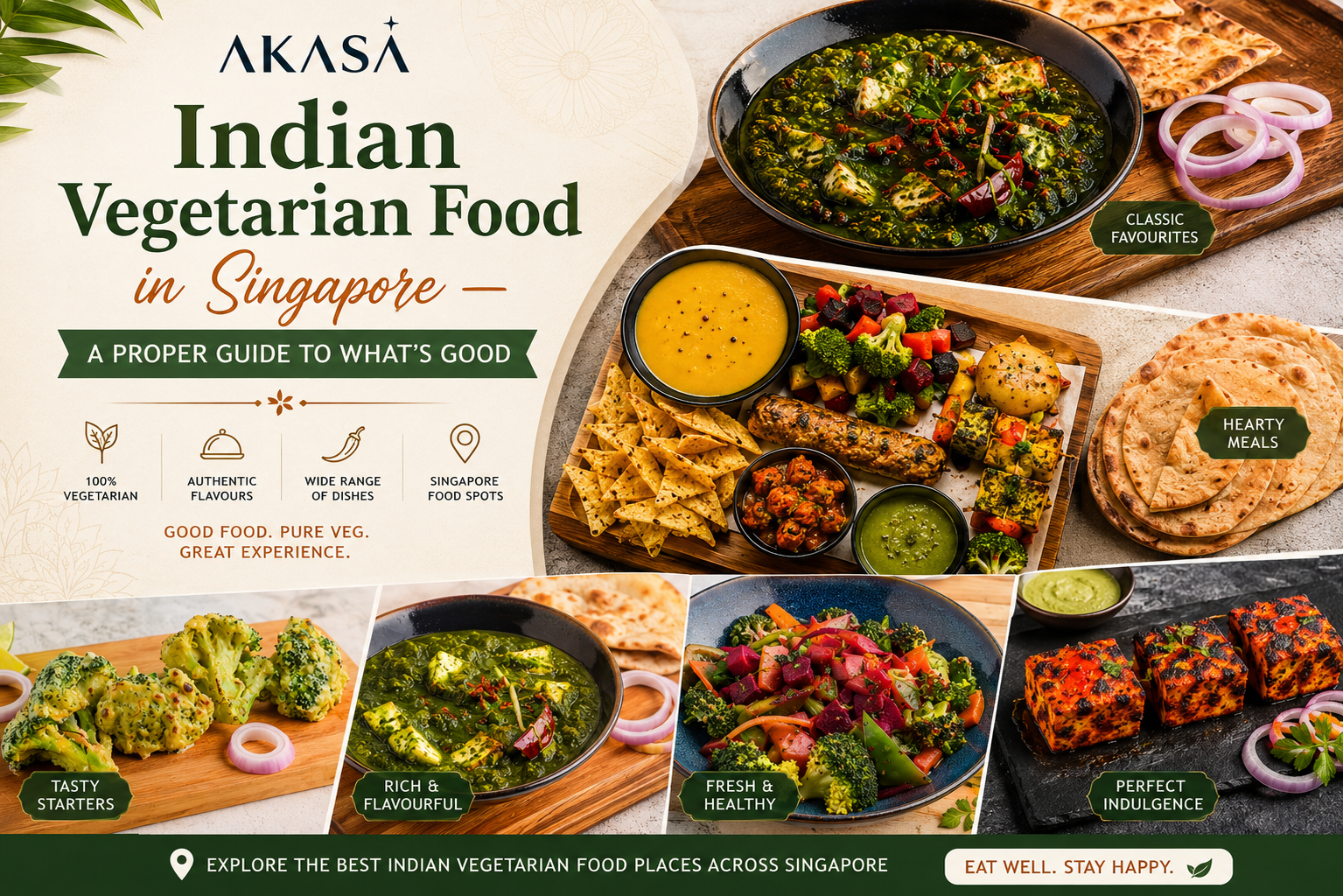
Indian vegetarian food in Singapore — a proper guide to what's good
TLDR
- Indian vegetarian food isn’t a compromise — it’s a full cuisine. Singapore does it well across every price point, from SGD 5 hawker dosas to SGD 120 fine dining tasting menus.
- North Indian food is rich and wheat-based (dal, paneer, naan). South Indian is sharper and rice-based (dosa, idli, sambar). Most South Indian dishes are naturally vegan. North Indian uses dairy heavily — ask about ghee if that matters.
- For fine dining, Akasa at 79 Robinson Road is the pick. Full vegetarian and vegan tasting menus, halal certified, in the CBD. Set lunch runs SGD 35 to 50 if you want to try it without a full dinner spend.
- For budget South Indian, Komala Vilas on Serangoon Road has been getting the masala dosa right since 1947.
- For Mumbai street food, Kailash Parbat near Orchard for pav bhaji and pani puri.
That covers most of what you need.
Here’s the thing nobody tells you about Indian vegetarian food: it was never the backup option. Not in India. Not historically. Entire regions, entire communities, ate vegetarian by default for centuries — because the cuisine was built that way. Dal, paneer, lentils, spiced vegetables, coconut, tamarind. These aren’t substitutions. They’re the actual food.
I say this because Singapore has a lot of Indian restaurants that treat vegetarian dishes like an afterthought. A few paneer curries, maybe a dal, something with mushrooms that doesn’t belong on the menu. That’s not what this guide is about.
This guide is about the places where Indian vegetarian food is taken seriously. Where the dal gets cooked for 24 hours. Where the dosa batter is fermented properly. Where the vegetarian tasting menu is as considered as everything else on offer. If you’re looking for an Indian restaurant in Singapore that treats vegetarian cooking as the main event rather than a courtesy, there are maybe 10 that clear that bar. I’ll tell you which ones.
What Indian vegetarian food actually is
Most people who didn’t grow up eating it picture Indian vegetarian food as curried vegetables with rice. That’s a bit like describing French cooking as bread with cheese. Accurate in the loosest sense, useless as a description.
Indian vegetarian food runs across an enormous range. Lentil dishes alone — dal makhani, toor dal, chana dal, moong dal — each cook differently, taste differently, pair with different breads and rice. Paneer (fresh cottage cheese, made and used same-day in good kitchens) fills the protein role that meat plays elsewhere. Chickpeas, kidney beans, various legumes do real work across the North Indian menu. Down South, it’s coconut milk, tamarind, and rice, with almost no dairy involved.
That last point matters if you’re vegan. A lot of South Indian vegetarian food is naturally vegan already. The North Indian side leans on ghee, cream, and butter — but those can usually be adjusted if you ask. Akasa has a dedicated vegan tasting menu built from scratch rather than adapted from the vegetarian menu. That’s unusual and worth knowing.
One practical thing: Indian vegetarian food in Singapore is spread across the whole city. You don’t have to go to Little India. The best Indian vegetarian restaurant in Singapore for fine dining is on Robinson Road in the CBD. Good Mumbai street food is near Orchard. The hawker options are in Little India, yes, but also Newton, Tekka, Geylang. The food travels.
North Indian vs South Indian vegetarian food — the actual difference
This matters more than most people realise. They’re genuinely different cuisines, not regional variations of the same thing.
North Indian vegetarian food is built around wheat. Naan, roti, paratha, puri. The gravies are rich — butter, cream, tomato. The spices are warm: cumin, coriander, garam masala, dried red chilli. Key dishes: dal makhani, paneer butter masala, palak paneer, aloo gobi, rajma, chole. The street food tradition runs to chaat — pani puri, pav bhaji, samosa, papdi chaat. Akasa works in this tradition at the fine dining level.
South Indian vegetarian food is rice-based and sharper. Dosas, idlis, uttapam, rice thali. The flavours lean sour and tangy — tamarind, kokum, curry leaves, mustard seeds. Key dishes: masala dosa, idli sambar, rasam, avial, kootu, pongal. Most of it is naturally vegan by default. Komala Vilas and MTR work in this tradition at the casual and hawker levels.
Neither is better. Eat both on the same trip if you can.
Indian vegetarian dishes worth knowing before you order
Nine dishes that come up across most Indian vegetarian restaurants in Singapore. Knowing what a good version looks like saves you from ordering something and wondering why it doesn’t taste right.
Dal Makhani. Black lentils and kidney beans, slow-cooked with butter and cream. Good versions take hours — some kitchens go overnight. The dal at Akasa, called Dal-e-Akasa, cooks for 24 hours. The difference in depth compared to a quick version is noticeable.
Masala Dosa. Rice and lentil crepe, crispy, filled with spiced potato. Should shatter slightly when you break it. If it’s soft and pliable, it wasn’t cooked long enough. Komala Vilas and MTR get this right.
Palak Paneer. Pureed spinach with fresh paneer. Simple in theory. The spinach should be bright green, slightly bitter, not grey-green and overcooked. The paneer should be soft enough to press with a fork. Done well it’s excellent. Done badly — which is most of the time — it’s grey mush with rubber cubes.
Paneer Tikka. Paneer marinated in spiced yoghurt and cooked in a tandoor. Good versions have char and smoke. At Akasa, the version comes with crushed nuts. Worth ordering.
Chole Bhature. Spiced chickpea curry with deep-fried puffed bread. The bread should be eaten immediately before it deflates. Kailash Parbat does this properly.
Pav Bhaji. Thick spiced vegetable mash with soft rolls and butter. Mumbai street food. Good when the butter isn’t held back. Kailash Parbat’s version is the strongest one I’ve had in Singapore.
Idli Sambar. Steamed rice cakes with lentil soup. Light, faintly sour, good for breakfast. The idli should be soft all the way through and slightly spongy. MTR does it right.
Rasam. A thin, sharp, pepper-and-tamarind broth. If you’re full but want to keep eating, rasam is the answer. Most South Indian restaurants serve it as part of a thali.
Gulab Jamun. Fried milk-solid balls soaked in warm sugar syrup. The dessert most people recognise. A good one is soft all the way through. A bad one has a dry, dense centre.
Best Indian vegetarian restaurants in Singapore
Fine dining
Akasa
79 Robinson Road, #01-03 CapitaSky, Tanjong Pagar Dinner SGD 60 to 120 per person. Set lunch SGD 35 to 50. Halal certified.
I keep coming back to Akasa when people ask about Indian vegetarian food in Singapore at the serious end because the kitchen doesn’t treat vegetarian as a reduced version of the non-veg menu. There’s a full vegetarian tasting menu. A separate vegan tasting menu designed without dairy from the ground up. Individual vegetarian dishes that get the same technique and sourcing as everything else.
Chef Akhilesh Pathak works out of a coal-fired tandoor and focuses on Awadhi cooking — the slow-cooked, technically demanding end of North Indian cuisine. The Dal-e-Akasa takes 24 hours. The Broccoli Kebab is charcoal-roasted and one of those dishes that makes you reconsider what a vegetable does when someone actually thinks about it. The Paneer Kebab comes with crushed nuts. The Paneer Tikka has proper tandoor char.
The set lunch is how I’d tell a first-timer to approach it. Good food, SGD 35 to 50, manageable timing. Dinner with the tasting menu is the full version.
The restaurant is halal certified. That’s a specific and important detail for Muslim diners looking for an Indian vegetarian restaurant in Singapore at the fine dining level — most are not halal certified, and the two certifications are separate. This one covers both.
It works for a date, a birthday, a work dinner, a group where some people eat meat and some don’t. The non-veg menu is equally strong, so nobody gets the shorter end.
Book a table or explore the vegetarian menu here. For the full Indian fine dining experience at Akasa, see here.
Order: Dal-e-Akasa, Paneer Kebab, Broccoli Kebab, vegetarian or vegan tasting menu
Firangi Superstar
Robertson Quay. Dinner SGD 60 to 90 per person.
Creative, theatrical, takes risks. The Romanesco cauliflower comes charred with spiced potato foam and a cashew-raisin vinaigrette. It sounds like too much and somehow isn’t. The room is designed to look like a 1970s officers’ club via Bollywood production design — you either find that fun or you don’t, but the food stands up regardless.
Best for groups who want something playful and don’t need a traditional dining room.
Annalakshmi Restaurant
20 Havelock Road, Central Square. Pay what you feel.
A pay-what-you-feel vegetarian buffet that’s been operating this way for decades. North and South Indian vegetarian food, home-style, reliably good. Not flashy. One of those places you eat at and wish was closer to where you live.
Mid-range
Nalan Restaurant
Little India and City Hall. SGD 25 to 50 per person.
Pure vegetarian. No onion, no garlic options. Dedicated vegan dishes, gluten-free options, dairy-free dishes. If you follow a Jain diet or have specific dietary requirements, Nalan handles it properly — not as a courtesy gesture but as a real part of the menu. Both branches are close to MRT stations
Kailash Parbat
Orchard Road and other locations. SGD 20 to 35 per person.
Mumbai street food, done properly. Pav bhaji, pani puri, chole bhature, bhel puri, dahi puri. The pav bhaji is the main reason to visit — thick spiced vegetable mash, buttered rolls, order it again before you finish the first round. Good for an afternoon snack or a casual dinner when you’re near Orchard.
Gokul Restaurant
Little India. SGD 20 to 35 per person.
This one gets skipped in most Indian vegetarian food guides and that’s a mistake. Gokul does mock meat — veg butter chicken, veg mutton biryani — using soy-based ingredients to replicate meat texture. There’s a real market for this, particularly among people who grew up eating those dishes before going vegetarian. The rest of the menu covers North and South Indian options well too.
Budget and hawker
Komala Vilas
76-78 Serangoon Road, Little India. SGD 8 to 18 per person. Fully vegetarian.
Open since 1947. Oldest Indian restaurant in Singapore still operating. The masala dosa is what most people order and it earns the reputation — crispy, soft inside, coconut chutney and sambar. The vegetarian thali is good for a first visit. Filter coffee in a steel cup. Prices are as low as Indian vegetarian food in Singapore gets while the food stays good.
MTR Singapore
438 Serangoon Road. SGD 12 to 22 per person.
Mavalli Tiffin Rooms from Bangalore, operating since 1924. The Singapore branch does traditional South Indian breakfast correctly — bisi bele bath, masala dosa, kesari bath, filter coffee. Go in the morning when everything is fresh. Not much ambience. Very good food.
Raj Restaurant
172 Race Course Road. SGD 15 to 25 per person.
Long menu. Dosas in many variations — onion, cheese, paper roast, masala. Paneer curries, various breads, gulab jamun. Good for groups with different preferences because the range covers most things. Nothing exceptional, nothing bad.
Tekka Centre hawker stalls
665 Buffalo Road, Little India. SGD 4 to 10 per person.
Wet market and hawker centre. Vegetable prata, thosai, various vegetable curries, teh tarik. The cheapest Indian vegetarian food in Singapore that’s still worth eating. Go early. No air conditioning.
Vegan Indian food in Singapore
Worth covering separately because vegetarian and vegan are not the same thing and the difference is practically significant when you’re ordering.
South Indian dishes are mostly vegan already. No dairy in dosas, idlis, sambar, rasam, most vegetable curries. Tamarind and coconut do the work instead of cream and butter. The issue is ghee — clarified butter used in most Indian breads and many gravies. It doesn’t always appear as a listed ingredient, so ask.
Akasa has a dedicated vegan tasting menu. Not a vegetarian menu with dairy removed — designed without it from the start. That’s the distinction. Nalan also marks dairy-free dishes specifically. Komala Vilas, MTR, and most South Indian casual places are easy to navigate as a vegan because the baseline food is already dairy-free.
Halal Indian vegetarian food in Singapore
Most Indian vegetarian restaurants in Singapore are not halal certified. This surprises people. Vegetarian and halal are separate certifications — a restaurant can be one, both, or neither.
Komala Vilas is not halal certified. MTR is not halal certified. Nalan is not halal certified. Annalakshmi is not halal certified.
Akasa is halal certified. It’s the strongest Indian restaurant in Singapore for vegetarian fine dining that also holds halal certification. If you’re a Muslim diner who wants vegetarian fine dining, or you’re booking for a group with both Muslim and vegetarian guests, 79 Robinson Road is the answer. Nobody has to pick a different dish.
More on halal fine dining at Akasa.
How to tell if an Indian vegetarian restaurant is actually good
Most bad Indian vegetarian food fails at the same places. Here’s what to look for before you order.
The dal. A kitchen that makes dal properly tells you a lot. Dal makhani should be thick, dark, and slightly smoky. If it’s thin and orange, they didn’t cook it long enough. If it tastes like a tin of tomatoes with lentils added, the base wasn’t built properly.
The paneer. Fresh paneer is soft and mild, slightly milky. Old or frozen paneer is dense, rubbery, and tasteless. You can tell within one bite. Good restaurants make their own or source it daily. Bad ones use the same block for three days.
The dosa. It should be crispy. If you’re eating it and it’s bending without breaking, the batter wasn’t fermented long enough or the pan wasn’t hot enough. A good masala dosa has a slight crunch when you tear into it.
The spicing. Indian vegetarian food should be layered — you should taste different spices at different points in a bite. Flat, one-note heat means they used chilli as a shortcut instead of building a proper spice base. Bland means they were afraid of the ingredients.
The ghee (in North Indian food). Ghee should be present but not overwhelming. If a dish tastes purely of grease, too much. If a dal or rice dish has no richness at all, they skimped.
What to order at an Indian vegetarian restaurant if you don’t know where to start
This is genuinely useful and most guides skip it. If you’re new to Indian vegetarian food in Singapore and don’t know what to pick, start here.
At a South Indian casual restaurant (Komala Vilas, MTR): Order the masala dosa with sambar and coconut chutney. Eat the dosa first while it’s still crispy. Drink the filter coffee. That’s the proper introduction.
At a North Indian casual restaurant (Kailash Parbat, Gokul): Order pav bhaji and pani puri. The pav bhaji is filling, the pani puri is fun to eat, and you’ll understand why Mumbai street food has the reputation it does.
At an Indian vegetarian fine dining restaurant (Akasa): Order the vegetarian tasting menu if it’s your first visit. It’s designed to show the range. If you want to pick individually, start with the Dal-e-Akasa and Paneer Tikka.
At a hawker centre (Tekka Centre): Ask for a vegetable thali or a plain masala thosai. Point at what other people are eating if the stall doesn’t have an English menu. Most stall owners will help you figure out what to order.
Indian vegetarian food and dietary restrictions — what to know
This comes up a lot in the questions I get, so it’s worth covering properly.
Onion and garlic. Some people following Jain dietary rules avoid onion, garlic, and root vegetables. Nalan Restaurant in Singapore specifically offers no-onion, no-garlic options. Most other Indian restaurants don’t. If this matters to you, call ahead.
Gluten. Indian food uses wheat heavily in the North — naan, roti, paratha. South Indian food is mostly rice-based and gluten-free by default. Dosas, idlis, rice, sambar — all fine. The issue is cross-contamination in kitchens that make both. Nalan marks gluten-free options. Other restaurants vary.
Nuts. Nut allergies are a real concern in Indian cooking because cashews, almonds, and pistachios appear in gravies, kebabs, and sweets, often not obviously. The Paneer Kebab at Akasa contains crushed nuts, for example. Always mention a nut allergy when booking.
Dairy. As covered in the vegan section — South Indian food is mostly dairy-free by default. North Indian food uses butter, cream, ghee, paneer, and yoghurt throughout. Akasa has a specific dairy-free vegan menu. Most other Indian restaurants will adjust dishes on request but it’s not a systematic approach.
Spice level. Indian vegetarian food in Singapore is generally adjusted for the local palate — less intense than you’d get in India. If you want it spicier, ask. Most kitchens are happy to adjust.
Indian vegetarian food for different occasions
Date night: Akasa or Firangi Superstar. Both have the food and the room to make an evening of it.
Birthday dinner: Akasa handles this well without overdoing the occasion gestures. Birthday dining details here.
Business lunch with a vegetarian client: Akasa’s set lunch. Good food, calm room, prices that work on an expense report. Business lunch options.
Family with kids: Kailash Parbat or Nalan. Familiar flavours, relaxed format, nobody needs to be quiet.
Solo meal: Komala Vilas or MTR. Cheap, fast, very good. Counter seating, no wait.
Group with mixed diets: Akasa. The non-vegetarian menu is equally strong, so vegetarians and non-vegetarians both get a proper meal.
Price guide
Hawker and self-service: SGD 5 to 15 per person. Tekka Centre, Komala Vilas, Ananda Bhavan, MTR.
Casual mid-range: SGD 20 to 40 per person. Kailash Parbat, Gokul, Raj Restaurant, Nalan.
Fine dining dinner: SGD 60 to 120 per person. Akasa, Firangi Superstar.
Set lunch fine dining: SGD 35 to 50 per person. Akasa set lunch — the most sensible way to try Indian vegetarian fine dining in Singapore without committing to a full dinner spend.
Vegetarian tasting menu: SGD 100 to 180 per person. Akasa’s full tasting menu experience.
Akasa at 79 Robinson Road is where I’d send anyone who wants Indian vegetarian food in Singapore taken seriously. The kitchen treats the vegetarian and vegan menus as full menus, not concessions. It’s halal certified. It works for almost any occasion. And the set lunch means you can try it without the full dinner commitment.
Make a reservation here.
Frequently Asked Questions
Akasa at Tanjong Pagar for fine dining. It’s the only Indian restaurant in Singapore where vegetarian diners get a fully built tasting menu rather than a reduced version of the non-veg menu. For budget South Indian vegetarian food, Komala Vilas on Serangoon Road has been correct since 1947.
No. Indian vegetarian food regularly uses paneer, ghee, cream, and yoghurt. A lot of South Indian food happens to be vegan by default because coconut and tamarind replace dairy. North Indian cooking uses dairy throughout. Akasa has a specific vegan menu built without any dairy. Most other Indian vegetarian restaurants in Singapore don’t have this.
Dal makhani, masala dosa, palak paneer, paneer tikka, chole bhature, pav bhaji, idli sambar. Those seven cover most of what appears across Indian vegetarian menus. The dishes section earlier in this guide covers each one in detail with what to look for in a good version.
Akasa at Robinson Road for fine dining — Awadhi cooking, tandoor dishes, slow-cooked gravies. Kailash Parbat for Mumbai street food. Gokul in Little India for a wider casual range including mock meat dishes.
Komala Vilas on Serangoon Road is the classic answer — operating since 1947, fully vegetarian, masala dosa and thali done correctly. MTR Singapore nearby does traditional South Indian breakfast properly. Nalan at Little India and City Hall covers South Indian dishes as part of a wider pure vegetarian menu.
Yes, but only at Akasa at the fine dining level. Akasa is halal certified and has a full vegetarian menu. Most other Indian vegetarian restaurants in Singapore are not halal certified. If you’re looking for halal Indian vegetarian food in Singapore for a mixed Muslim and vegetarian group, Akasa is the clearest answer.
Tekka Centre hawker stalls in Little India run SGD 4 to 10 for a full meal. Komala Vilas and Ananda Bhavan are both under SGD 20 for a proper spread. MTR Singapore is similar. You can eat very well on a small budget.
It’s specifically good for vegetarians. Separate vegetarian and vegan tasting menus. Individual dishes with proper technique — the Paneer Kebab, Broccoli Kebab, Dal-e-Akasa, Paneer Tikka are all strong. For anyone who usually gets the short end of the menu at an Indian restaurant in Singapore, this is the exception.
Indian vegetarian includes dairy. Indian vegan doesn’t. South Indian food tends to be vegan by default. North Indian uses butter, cream, and paneer throughout. Ghee is the hidden issue — it appears in bread and gravies without always being listed. At Akasa, the vegan tasting menu is designed dairy-free from the start rather than being a modified vegetarian menu.
Yes. Akasa is on Robinson Road, five minutes from Tanjong Pagar MRT, right in the CBD. For a vegetarian Indian lunch in the central business area without leaving the district, the set lunch at Akasa is the strongest option. There are also hawker options near Raffles Place for a cheaper meal.
Recent Posts
Bulk Diwali Gifts for Companies Singapore: 2026 Corporate Gifting Guide

Diwali Office Gifts Singapore Corporate Teams Will Appreciate

Meaningful Diwali Return Gift Ideas Singapore Guests Will Love
Indian Restaurant for Diwali Party: Top 2026 Singapore Venues

Best Place to Celebrate Diwali: Top Diwali Festival Spots in Singapore
View More Articles
Bulk Diwali Gifts for Companies Singapore: 2026 Corporate Gifting Guide
September 24, 2026
Diwali Office Gifts Singapore Corporate Teams Will Appreciate
September 24, 2026 Meaningful Diwali Return Gift Ideas Singapore Guests Will Love
September 24, 2026 Indian Restaurant for Diwali Party: Top 2026 Singapore Venues
September 24, 2026