- Restaurants
- April 22, 2026
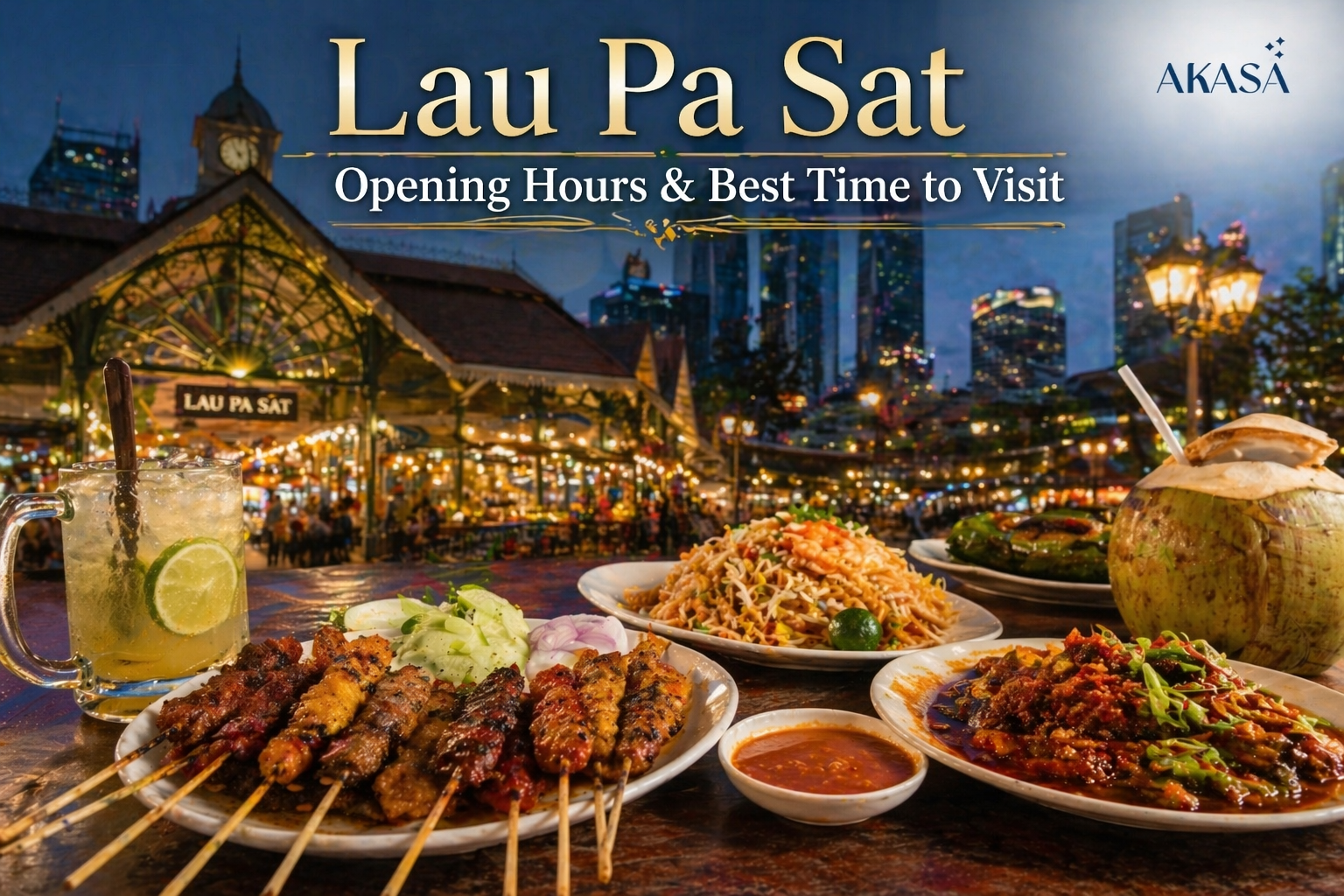
Lau Pa Sat Opening Hours, Satay Street Timings & Complete Visitor Guide (2026)
Picture this Friday night, 8 PM, somewhere in the CBD. The office towers are all lit up above you, there’s actually a breeze for once, and if you walk a few minutes south from Raffles Place MRT, you’ll hit that wall of charcoal smoke and grilled meat smell that means Lau Pa Sat opening hours have kicked in for the evening.
If you’ve never been, or you’ve been once and turned up at the wrong time and found half the stalls shuttered — this guide is for you. If you’re a tourist who’s got one free sunset to work with, an expat who’s listened about Satay Street and keeps putting off leaving, or a local with tourists from back home who need a proper Singapore experience, you need it all here.
Lau Pa Sat Opening Hours, Satay Street Timings & Complete Visitor Guide (2026)
Picture this Friday night, 8 PM, somewhere in the CBD. The office towers are all lit up above you, there’s actually a breeze for once, and if you walk a few minutes south from Raffles Place MRT, you’ll hit that wall of charcoal smoke and grilled meat smell that means Lau Pa Sat opening hours have kicked in for the evening.
If you’ve never been, or you’ve been once and turned up at the wrong time and found half the stalls shuttered — this guide is for you. If you’re a tourist who’s got one free sunset to work with, an expat who’s listened about Satay Street and keeps putting off leaving, or a local with tourists from back home who need a proper Singapore experience, you need it all here.
What Is Lau Pa Sat? Singapore’s Most Iconic Hawker Centre Explained
Worth knowing what you’re walking into before we get to the hours. Lau Pa Sat is not a food court. It’s not a shopping mall food lobby. It’s something else totally.
“Lau Pa Sat” is Hokkien for “old market.” The location also goes by Telok Ayer Market, and it is situated at 18 Raffles Quay, right in the middle of Singapore’s Central Business District. Probably the most photographed and most visited hawker areas in the whole country. Possibly that sounds like a tourist-trap area. It isn’tSize-wise, we’re discussing over 52,000 square feet and more than 80 food stalls. The extent is wide: Hainanese chicken rice, Hokkien mee, Korean BBQ, Vietnamese pho, Turkish food, and Japanese ramen. All of it under one very ornate Victorian roof.
Then there’s Satay Street. Every evening, Boon Tat Street — the road running directly outside the market — gets closed to traffic. Satay stalls set up along the full stretch of it, charcoal grills going, and suddenly you’ve got one of the more atmospheric outdoor dining experiences the city has. We’ll get into the specifics of that below.
If you’re examining the broader food view around the area, this guide to Amoy Street food covers some outstanding spots just min away from Lau Pa Sat.
Lau Pa Sat Opening Hours: The Complete 2026 Breakdown
Main Hawker Centre Opening Hours
Lau Pa Sat is open 24 hours a day, 7 days a week, every day of the year.
The building never closes. That part’s true. But “24/7” refers to the market being approachable, not every stall inside it. Personal vendors set their own hours, and most of them are done somewhere around 9 PM and 11 PM. A handful keep going over the night. So what you find at 2 AM looks different from what you find at midday.
Here’s how the day really plays out:
Early Morning (6 AM – 10 AM) A few brunch stalls are open, kaya toast, kopi, congee, the usual. Quiet. Most people catch something fast before heading to work. Pleasant time to go if you just want the area to yourself without the conflict for a table.
Mid-Morning to Lunch (10 AM – 2 PM) Most stalls are energetic by 10 or 10:30. Then lunchtime hits, and the CBD drains into Lau Pa Sat. The lunch group is honestly robust on weekdays, 12 PM to 2 PM, and queues at the well-known markets like Lao Fu Zi Fried Kway Teow and Seng Kee Local Delights can run 20 min easy. If you’re on a tight lunch break, factor that in.
Afternoon (2 PM – 5 PM) Things calm down after 2. A lot. This window is honestly one of the most underrated times to visit — stalls still open, seating available, no queue pressure, nobody hovering waiting for your table. Just you and the food.
Evening (5 PM – 10 PM) Energy selects back up as the day pack morphs into the dinner crowd. Satay Street begins at 7 PM on weekdays, 3 PM on weekends. Charcoal smoke in the air, outdoor room filling up, the old Victorian building sharp against the city skyline, this is honestly the best version of Lau Pa Sat. The type of thing you’d actually tell someone about.
Late Night (10 PM – 3 AM) Indoor stalls mostly wrap up by 10. Satay Street goes until 3 AM. Past midnight, the indoor options get slim, but the outdoor atmosphere stays very much alive — and somehow feels more local the later it gets.
Lau Pa Sat Satay Opening Hours: Satay Street Timings
Most people searching for Lau Pa Sat specifically want this, so here it is clearly.
Lau Pa Sat Satay Street (Boon Tat Street) Opening Hours:
Day | Opening Time | Closing Time |
Monday – Friday (Weekdays) | 7:00 PM | 3:00 AM |
Saturday | 3:00 PM | 3:00 AM |
Sunday & Public Holidays | 3:00 PM | 3:00 AM |
A few things about Lau Pa Sat satay opening hours that actually matter in practice:
Road closure: When Satay Street opens, Boon Tat Street shuts to traffic completely. The whole road becomes tables and chairs, an open-air dining strip that fits hundreds of people at once.
The stalls: About ten satay stalls along Boon Tat Street. All of them use charcoal, not gas. That’s not a small detail; it’s what gives the meat the smoky char that you genuinely can’t get any other way. Chicken, beef, mutton, prawn. You pick, you order by the stick, it comes to you with peanut sauce, compressed rice (ketupat), cucumber, and onion.
Best stalls: Stalls 7 and 8 come up again and again when you ask locals who’ve been going for years. Both do halal and non-halal. You tell the stall holder how many sticks, grab a seat at the communal tables, and wait.
Arrive early on weekends: By 8:30 PM on a Friday or Saturday, every table on Satay Street is full. If you want to truly sit down smoothly, 7 PM on weekdays or 4 PM on weekends is a much better call than showing up at peak hour and floating crudely.
Weather: It’s all outdoors. Singapore’s rainy season runs from November to January, and an afternoon bath can upset the whole setup. Stalls pick back up once the rain pauses, but it’s worth checking the forecast before committing to a weekend evening plan.
Individual Stall Opening Hours at Lau Pa Sat
The stalls people actually ask about, and when they’re open:
Lao Fu Zi Kway Teow (Stall 74–75) Michelin-recognised char kway teow. The wok hei here is the real thing, proper smoky char, fresh components, quality that’s persistent enough to earn the understanding. Hours: Sunday to Friday, 11:45 AM – 10 PM | Saturday: 1 PM – 10 PM
Feng Xiang Bak Kut Teh (Stall 27) Cantonese-style herbal bak kut teh. Stronger to find in Singapore than the Hokkien peppery version, and worth searching out, especially. Hours: Daily, 10:30 AM – 9:30 PM
Thunder Tea Rice (Stall 25) Hakka robust suit: brown or white rice with chopped greens, peanuts, fried sprats. One of the lighter options at Lau Pa Sat if you don’t want something heavy. Hours: Daily, 10 AM – 10 PM
LiXin Teochew Fishball Noodles Michelin Bib Gourmand. Fishball noodles done well, constantly. Hours: Daily (worth checking directly with the stall for current timings)
Seng Kee Local Delights (Stall 10) One of the older stalls here, still drawing orders every single day. Hours: Daily, 8 AM – 10 PM
Qiu Lian Ban Mian (Stall 16) best ban mian, a decent range of noodle styles to select from. Hours: Daily, 10 AM – 8 PM
Butter & Cream Bakery (Stall 5–6) Café pastries, salted egg lava tarts, baked stuff. No pork, no lard. Hours: Monday–Thursday 10 AM – 9 PM | Friday 10 AM – 10 PM | Saturday 10:30 AM – 10 PM | Sunday 10:30 AM – 9 PM
Halal Stall choices at Lau Pa Sat:
- A.M. Mohamed Food (Stall 54)
- Ipoh Hainanese Chicken Rice (Stall 14)
- Turkish Cuisine (Stall 70)
Vegetarian Stall choices at Lau Pa Sat:
- Maya Veggie Delight (Stall 47)
- Shree Bhaavan Pure Indian Vegetarian (Stall 40)
- Su Xiang Chinese Vegetarian Cuisine (Stall 46)
Vegetarian restaurants seeking a full sit-down lunch in the CBD will find plenty more choices. Akasa’s vegetarian restaurant in Singapore is a popular option just min away in Tanjong Pagar.
Best Time to Visit Lau Pa Sat (Honest Assessment)
No single perfect time. It really does hang what you’re there for.
If you want the full Satay Street experience: Weekday evenings, 7:30 PM to 9:30 PM. Satay Street’s in full swing, the indoor delays are still passing, so you can mix satay with other dishes, and the environment is right. This is the variant of Lau Pa Sat that stays in your head.
If crowds are something you’d rather avoid: Weekday afternoon, 2 PM to 5 PM. After the lunch hour clears out, it gets genuinely calm. Stalls are still stocked, seats are simple, no stress on any front.
If you want the best weekend version, get there Saturday or Sunday around 4 PM. Satay Street opens at 3 PM on weekends, so arriving an hour in means you get a good table before the evening group builds.
If you’re a night owl type, after 9 PM on a weeknight. Indoor options are narrowing, but Satay Street goes until 3 AM, and the whole thing shifts to a quieter, more local energy that’s actually kind of nice.
If you’re a tourist with limited time, 6:30 PM to 9 PM on any evening. You get both the indoor hawker centre and Satay Street in one call, with sufficient early light at the start to take in the Victorian structure properly.
What to actually avoid: The weekday lunch rush, 12 PM to 2 PM. Unless queues genuinely don’t bother you, that window is a lot of standing around.
How to Get to Lau Pa Sat: MRT, Bus & Walking Routes
Address: 18 Raffles Quay, Singapore 048582
Three MRT stations within easy walking distance. Hard to get stranded here.
By MRT
Telok Ayer MRT (Downtown Line, Exit A): Immediate. Three to five min on foot. Best if you’re coming from Chinatown, Marina Bay, or anywhere in the Downtown Core.
Raffles Place MRT (East-West and North-South Lines, Exit H or I): Five to seven min. Good if you’re approaching City Hall, Jurong East, Pasir Ris, or Changi terminal management.
Downtown MRT (Downtown Line): Five to eight min. Works if you’re coming from Bugis, Promenade, or Bayfront.
Walking from Raffles Place MRT Exit H or I, walk south along Raffles Quay. The octagonal clock tower shows up within five minutes. It’s not subtle — you’ll see it among the towers.
Late Night note: If you’re leaving after 2:30 or 3 AM when Satay Street wraps up, MRT has been closed for a while at that point. Grab or taxi — the CBD location means pickup is usually quick. If you’re planning a full evening in this part of the city, our guide to dinner spots in Singapore’s CBD offers useful choices for before or after your Lau Pa Sat.
What to Eat at Lau Pa Sat: The Full Food Guide
Above 80 stalls, food from all over Asia, and the very real problem of not learning where to start. An organised way to think about it:
Singaporean Hawker Classics
Hainanese Chicken Rice is Singapore’s national dish by most people’s count. Steamed or roasted chicken, rice baked in chicken broth, three condiments: chilli sauce, ginger paste, dark soy sauce. The dish sounds simple, and it is. The quality difference between a great plate and an average one comes down almost entirely to the rice. Fragrant, oily, aromatic done right. Stodgy and bland done wrong.
Char Kway Teow: flat rice noodles, high heat, prawns, Chinese sausage, egg, bean sprouts. The thing that makes or breaks it is wok hei, that specific smoky breath of a very hot wok working fast. Lao Fu Zi at Stall 74–75 has Michelin recognition and earns it.
Hokkien Mee: Yellow noodles and skinny rice noodles together, boiled in prawn and pork stock, assisted with sambal and lime. Savoury, moderately briny, the sort of dish locals eat without reasoning much about it. Which is the greatest compliment?
Laksa Coconut milk noodle soup: spicy, creamy, and aromatic all at the same time. Prawns, fish cake, tofu, cockles. One bowl covers a meal on its own, usually.
Bak Kut Teh pork ribs are slow-cooked in herbal or peppery broth. Feng Xiang at Stall 27 does the Cantonese herbal style — darker, more complex than the Hokkien peppery version. Worth the difference if you’ve only had one kind before.
Satay Skewered meat charcoal-grilled and served with peanut sauce. Chicken, beef, mutton, prawn. The Satay Street version at Lau Pa Sat has the setting working in its favour in a way that’s hard to beat — food tastes better when the whole surrounding experience is this good.
BBQ Stingray pickled in sambal, grilled on a banana leaf until the edges char and the flesh goes smooth. A hawker staple that surprises a lot of first-timers with how truly good it is.
Lighter Bites and Alternatives
Thunder Tea Rice (Stall 25): Hakka dish — grains, greens, peanuts, and herbal tea poured over. One of the few genuinely light options at Lau Pa Sat.
Fishball Noodles: LiXin’s Bib Gourmand-recognised version uses fishballs with a higher fish-to-starch ratio than the budget alternatives.
Ban Mian: Handmade flat noodles in obvious anchovy broth, minced pork, fried shallots, and soft-poached egg. Qiu Lian at Stall 16 does a solid variant.
Kopitiam Breakfast: Kaya toast, soft-boiled eggs, kopi. The classic local breakfast. Seng Kee at Stall 10 opens from 8 AM if you’re the early type.
Lau Pa Sat History: 200 Years of Singapore’s Oldest Market
The place has been here, in several forms, since 1824. That’s valuable, knowing when you’re sitting inside it.
Stamford Raffles arranged a market built at Telok Ayer, a coastal bay at the time, the landing place for Chinese immigrants coming to early colonial Singapore. The first version was timber and attap, sitting on piles over the water. Fishermen empty straight onto the market floor.
By 1833, it had deteriorated enough to need replacing. George Drumgold Coleman — Singapore’s first Government Superintendent of Public Works — designed the new one. He used an octagonal shape. Every version of the market since has kept that.
1879: Land reclamation at Telok Ayer Basin meant the market had to go. Municipal Engineer James MacRitchie redesigned it — kept Coleman’s octagonal layout, upgraded to Victorian prefabricated cast iron from Walter MacFarlane & Company’s foundry in Glasgow. The same foundry that did the ironwork for the Raffles Hotel. The rebuilt Telok Ayer Market opened in 1894. 55,000 square feet.
By the 1970s, it wasn’t operating as a wet market any longer. In 1973, the building was gazetted as a National Monument, among the first in Singapore. Then, in 1986, the MRT channel under the site required the whole thing to come lower. Every one of the 3,000 cast-iron parts was tagged, logged, and collected. By 1989, it had been reunited piece by piece, renamed Lau Pa Sat, and resumed serving food.
A renovation in 2014 enhanced ventilation and enlarged the space. The Victorian facade and clock tower didn’t change.
Today, it’s the only hawker centre in Singapore that’s also a National Monument. One of the ancient Victorian cast-iron frames stands everywhere in Southeast Asia.
Lau Pa Sat vs Other Singapore Hawker Centres: How Does It Compare?
Feature | Lau Pa Sat | Maxwell Food Centre | Newton Food Centre | Old Airport Road Food Centre |
Opening Hours | 24 hours | ~8 AM – 10 PM | ~12 PM – 2 AM | ~6 AM – 10 PM |
Location | CBD / Raffles Quay | Chinatown | Newton | Kallang |
Satay Street | Yes (evenings) | No | Yes (limited) | No |
Heritage Status | National Monument | No | No | No |
Tourist Friendly | Very high | High | High | Moderate |
Halal Options | Yes | Yes | Yes | Yes |
Vegetarian Options | Yes | Limited | Limited | Yes |
Nearest MRT | Telok Ayer / Raffles Place | Chinatown | Newton | Dakota |
Price Range | $ – $$ | $ | $$ | $ |
Practical Tips for Your Lau Pa Sat Visit
Bring some cash. PayNow, NETS, PayLah, GrabPay — most stalls take them. But the older satay vendors on Boon Tat Street often still want cash, and running out mid-meal is a pain. SGD 20–50 in your pocket covers it.
Dress for the heat. Inside, the Victorian building’s ventilation and ceiling fans make it tolerable. Satay Street is completely exposed — breathable clothing matters a lot on a warm weekend evening.
Arrive early for satay. The prawn satay especially goes fast. The first hour after Satay Street opens is when the selection is widest.
Go hungry, share widely. Best done in a group — order from multiple stalls, put it all on the table, and share. Four people, eight to ten dishes, SGD 15–20 each. That’s the right way to do it.
Check for the Michelin-recognised stalls. Lao Fu Zi Fried Kway Teow at Stall 74–75 and LiXin Teochew Fishball Noodles both have Michelin recognition — both are worth a queue, and there usually is one.
Weekday afternoons are underrated. 2 PM to 5 PM on a weekday is the quietest the market gets while still being fully operational. Stalls stocked, seats free, no pressure at all.
After Lau Pa Sat: Elevate Your Evening at Akasa
Lau Pa Sat does hawker culture the right way — unpretentious, vibrant, the kind of meal that feels like the real Singapore. But if the mood shifts and the evening feels like it wants something different after that, Akasa is ten minutes away and a completely different world.
It’s at 79 Robinson Road, #01-03 Capitasky, Tanjong Pagar — modern Indian fine-dining, right in the CBD. Where Lau Pa Sat is about the democratic, open, everyone-welcome energy of hawker food, Akasa is about the regal tradition of India’s royal kitchen. Different entirely. Works surprisingly well as a pairing.
At Akasa, you'll find:
- A seasonal à la carte menu drawing from the culinary traditions of India’s royal households
- Elevated Indian tasting menus designed for long, leisurely dinners
- An extensive wine list and handcrafted cocktail programme
- A curated selection of Indian-inspired desserts (mithai) and bar bites
- Saturday brunch service and private dining for special occasions
- Vegan and plant-forward menu options
Akasa is extensively viewed as one of the finest Indian restaurants in Singapore, merging heritage methods with current fine-dining craft in the core of the CBD.
Akasa Opening Hours: Monday to Saturday — Lunch: 11:30 AM – 2:30 PM | Dinner: 5:30 PM – 9:30 PM Contact: +65 8012 1181 | info@akasa.sg
Good for a special occasion dinner, good if you’re just curious what Indian culinary heritage looks like through a fine-dining lens. If you’re in view of a special dinner after your hawker evening, Akasa also provides Indian fine dining in Singapore with tasting menus and private dining choice value planning ahead.
Lau Pa Sat has been feeding people for over 200 years. That’s not a marketing line — it’s just what the place is. A living piece of the city’s history that also happens to serve very good food at very reasonable prices, whether you show up at noon, at 8 PM, or at 1 AM when you’re out of other ideas.
Getting the Lau Pa Sat opening hours right — and especially the Lau Pa Sat satay opening hours — is the difference between a frustrating visit and one that actually delivers. Timing matters more here than at most places. Get it right, arrive hungry, and if the evening feels like it has another chapter left in it, Akasa is ten minutes away and ready for a completely different kind of night.
Frequently Asked Questions
Yes — the Lau Pa Sat hawker centre building is open 24 hours a day, every day of the year. That said, not every stall inside keeps 24-hour hours. Most vendors run from around 10 AM to 10 PM, with a smaller number staying open overnight.
The Lau Pa Sat satay stalls on Boon Tat Street open at 7 PM on weekdays and 3 PM on weekends and public holidays. Closing time is around 3 AM across the board.
Yes, always open. On public holidays, Satay Street follows the weekend schedule — opening at 3 PM instead of 7 PM.
Weekday afternoons between 2 PM and 5 PM. The office lunch crowd is gone, most stalls are still running, and the place is as relaxed as it gets.
Yes. Halal-certified stalls include A.M. Mohamed Food (Stall 54), Ipoh Hainanese Chicken Rice (Stall 14), and Turkish Cuisine (Stall 70). Satay Street stalls also offer halal options.
Yes. Dedicated vegetarian stalls: Maya Veggie Delight (Stall 47), Shree Bhaavan Pure Indian Vegetarian (Stall 40), and Su Xiang Chinese Vegetarian Cuisine (Stall 46).
Telok Ayer MRT, Downtown Line, Exit A — about 3 to 5 minutes on foot. Raffles Place MRT, Exit H or I, is also closed for 5 to 7 minutes.
Around 3 AM, weekdays and weekends both.
No reservations, no booking — hawker centre and Satay Street seating is walk-in, first-come. Sharing tables with strangers during busy periods is just how it works.
Yes, genuinely. As Singapore’s only National Monument hawker centre, the combination of heritage architecture, food variety, and authentic local atmosphere is something you won’t find replicated anywhere else. Satay Street in the evening, especially — that’s a specifically Singaporean experience.
Recent Posts
View More Articles