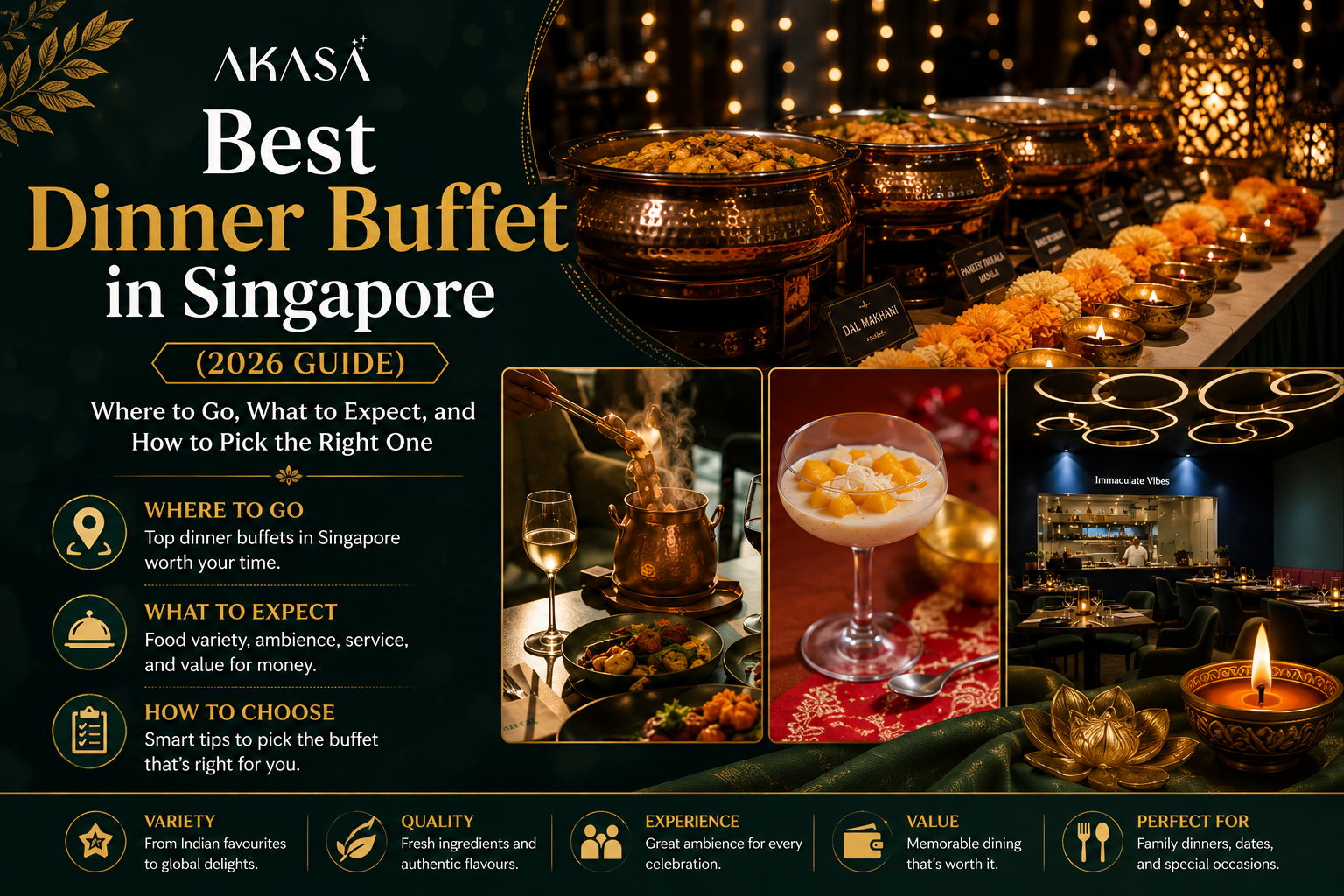
- Restaurants
- May 13, 2026

Singapore has too many restaurants and too many listicles telling you to visit the same five places. Most of those lists were written by someone who hasn’t eaten there recently, or at all.
This one’s different. These are 20 dinner ideas in Singapore that actually work — different occasions, different budgets, different group sizes. Some are specific restaurants. Some are food experiences worth planning around. All of them have a reason to be here.
1. Go Properly North Indian — Not Just Butter Chicken and Call It a Night
Most people’s experience with North Indian food in Singapore stops at butter chicken and garlic naan. Which is fine, but it’s like going to Japan and only eating sushi rolls.
A real North Indian dinner means starting with something like papdi chaat or samosa with the right chutneys, then moving into a proper main spread — dal makhani that’s been slow-cooked, paneer in a thick gravy, maybe a lamb dish if you eat meat, fresh roti or naan, and a portion of fragrant basmati. The food tells a story when it’s put together properly.
Akasa is worth going to for this. It’s the kind of indian restaurant in Singapore that takes the food seriously without making the dining experience feel like a cultural lecture. You sit down, you eat well, you leave full and genuinely satisfied. That’s the benchmark.
2. Hawker Centre Dinners Are Underrated by the People Who Live Here
Tourists queue for them. Expats discover them. And locals who grew up eating at hawker centres somehow stop going once they start earning a bit more money. That’s a mistake.
Lau Pa Sat on a weekday evening — before the satay stalls set up outside — is genuinely one of the better dinner experiences in Singapore. Char kway teow, BBQ stingray, rojak, a cold Tiger. Under $25 for two people. The fluorescent lights are not romantic. The plastic stools are not comfortable. It doesn’t matter.
3. Biryani — But Only the Good Kind
There is a real difference between biryani that was made fresh and biryani that sat in a pot for three hours. Most people have only had the second kind, which is why some people don’t rate biryani highly.
When the rice is properly layered, when the dum cooking is done right and the steam has done its job through the whole pot, biryani is one of the most complete dishes you can eat. Find a restaurant that makes it fresh. Sit down and eat it there. Don’t get it delivered — the texture suffers badly in transit.
4. CBD After-Work Dinner — Pick the Right Spot or You’ll Regret It
After-work dinners in the CBD area have a specific failure mode: you end up somewhere crowded, the service is stretched because the whole neighbourhood came out at the same time, and the food takes 40 minutes while you’re already tired and slightly hungry.
The fix is simple — book ahead, even for casual places, and aim for 7:30pm rather than 6:30pm. The first wave of office dinners is brutal. The second wave is much more manageable. Restaurants near Guoco Tower, Tanjong Pagar, and Robinson Road are the most convenient for CBD workers. Akasa handles this crowd well — the service keeps pace even when it’s busy.
5. Indian Vegetarian Dinner — Genuinely, Not as a Default
People book Indian vegetarian dinners for two reasons. Either they’re vegetarian, or they’re eating with someone who is and defaulted to Indian because “at least there are options.”
What they often discover is that the vegetarian food is the more interesting menu. Dal tadka with a proper tarka of ghee, cumin, and dried chillies. Aloo gobi that has texture. Paneer dishes with actual depth. You don’t feel like you compromised on dinner. You feel like you had a proper meal.
If you’re in the second group — the one who didn’t choose Indian for themselves — you’ll probably suggest it next time without being asked.
6. Sit-Down Birthday Dinner at a Restaurant That Gets It Right
Birthday dinners at restaurants go wrong in specific ways. The place is too loud. The service rushes the group because the table needs to turn. The “surprise” dessert situation is awkward. The bill calculation at the end takes fifteen minutes.
A good birthday dinner restaurant handles all of this without you having to manage it. Tell them it’s a birthday when you book. Tell them the rough group size and whether you want a dessert moment. A place like Akasa handles private group bookings for occasions like this — the food is celebratory enough and the setting is right for an actual sit-down dinner rather than just a table that happens to have people at it.
7. Corporate Dinner — First, Think About What You’re Actually Trying to Do
Most corporate dinners fail not because the food is bad but because no one thought about what they were trying to achieve. If it’s about impressing a client, the venue matters as much as the menu. If it’s a team appreciation dinner, the atmosphere matters more than the food quality.
For client entertainment, a well-regarded Indian fine dining restaurant works better than most people expect. It’s not the default choice, which actually makes it more memorable. Clients who’ve been to twenty corporate dinners at the same few hotel restaurants notice when someone picks something genuinely interesting. The food at a proper indian restaurant in Singapore gives you conversation throughout the meal, which is the actual point of a business dinner.
8. The Romantic Dinner Problem (And How to Actually Solve It)
Every “romantic restaurants in Singapore” list says the same things. Views of Marina Bay. Candles. Overpriced tasting menus.
Here’s what actually makes a dinner romantic: the conversation is easy, the food is interesting enough to talk about, neither person is watching the clock, and you don’t leave feeling like you overpaid for atmosphere.
Indian cuisine delivers on most of this. You’re sharing dishes, making choices together, and the flavours are distinct enough to create natural moments of reaction and conversation. It’s more engaging than two people eating separate plates of steak in silence in a very expensive room with a good view.
Check out romantic restaurants in Singapore for a broader range of options if Indian food isn’t your person’s first choice.
9. Family Dinner — The One Where Everyone Has an Opinion
Organizing family dinners in Singapore means navigating three generations of different preferences, at least one dietary restriction, and someone who “doesn’t want to go anywhere too far.”
Buffet formats help. Indian buffets specifically help because the variety covers almost every preference — vegetarian dishes, meat dishes, mild options, spicy options, rice, bread, and something sweet at the end. Nobody has to order something they don’t want. The table looks abundant. The kids find something. The grandparents are happy. It works.
10. Dinner and Drinks — Don’t Separate Them
Some restaurants in Singapore have excellent food but a weak drinks list. Some bars do the opposite. The right call, when you want both, is a restaurant that treats the drinks as part of the experience rather than an afterthought.
For Indian cuisine, this often means a well-curated cocktail list that complements the spices — something cooling or citrus-forward alongside a rich curry works better than you’d expect. Akasa does this thoughtfully. The combination of good food with considered drinks is one of the easier ways to make a weeknight dinner feel like more than just eating.
More dinner and drinks places in Singapore if you’re planning around this.
11. The Slow Sunday Dinner
Nobody talks about this enough. The slow Sunday dinner — no reservation anxiety, no deadline, nowhere to be afterward — is one of the genuinely good things about living in Singapore.
You pick somewhere comfortable. You order more than you planned to. You eat slowly. The conversation goes wherever it goes. By the time you’re done, it’s been two and a half hours and it didn’t feel that long.
North Indian food suits this pace well. The dishes are layered, the bread is best hot and ordered in rounds, and there’s no natural stopping point until you decide there is. Akasa is a consistent choice for this kind of dinner — the pace of service matches a relaxed evening, not a rushed one.
12. Indian Chaat for Dinner — Don’t Dismiss It
Chaat as a dinner idea in Singapore, gets overlooked because people think of it as a snack. That framing is wrong when you’re eating it properly.
Pani puri, papdi chaat, dahi bhalla, pav bhaji — a spread of four or five of these with the right chutneys is a complete meal. The flavours hit every register: sour, sweet, spicy, cooling, crunchy. It’s one of the more fun eating experiences you can have at a dinner table, and it suits groups that want to share and graze rather than order structured courses.
13. Thali Dinner — For People Who Can’t Decide (Which is Most People)
A thali is the solution to the problem of having too many options. A single platter with small portions of dal, curry, sabzi, pickle, rice, bread, and something sweet. You get variety. You get balance. You get a complete picture of the cuisine in one sitting.
For anyone who hasn’t explored Indian food much, a thali dinner ideas in Singapore is the most efficient introduction available. For people who know Indian food well, it’s just a satisfying meal.
14. Rooftop dinner ideas in Singapore — Once, For the Right Occasion
Rooftop dinners in Singapore are worth doing at least occasionally. The city after dark looks genuinely good from a height, and there are a handful of restaurants that combine the setting with food that’s actually worth eating.
Don’t make it a regular dinner habit — the premium for the view gets old quickly. But for the right occasion, a rooftop table is hard to beat.
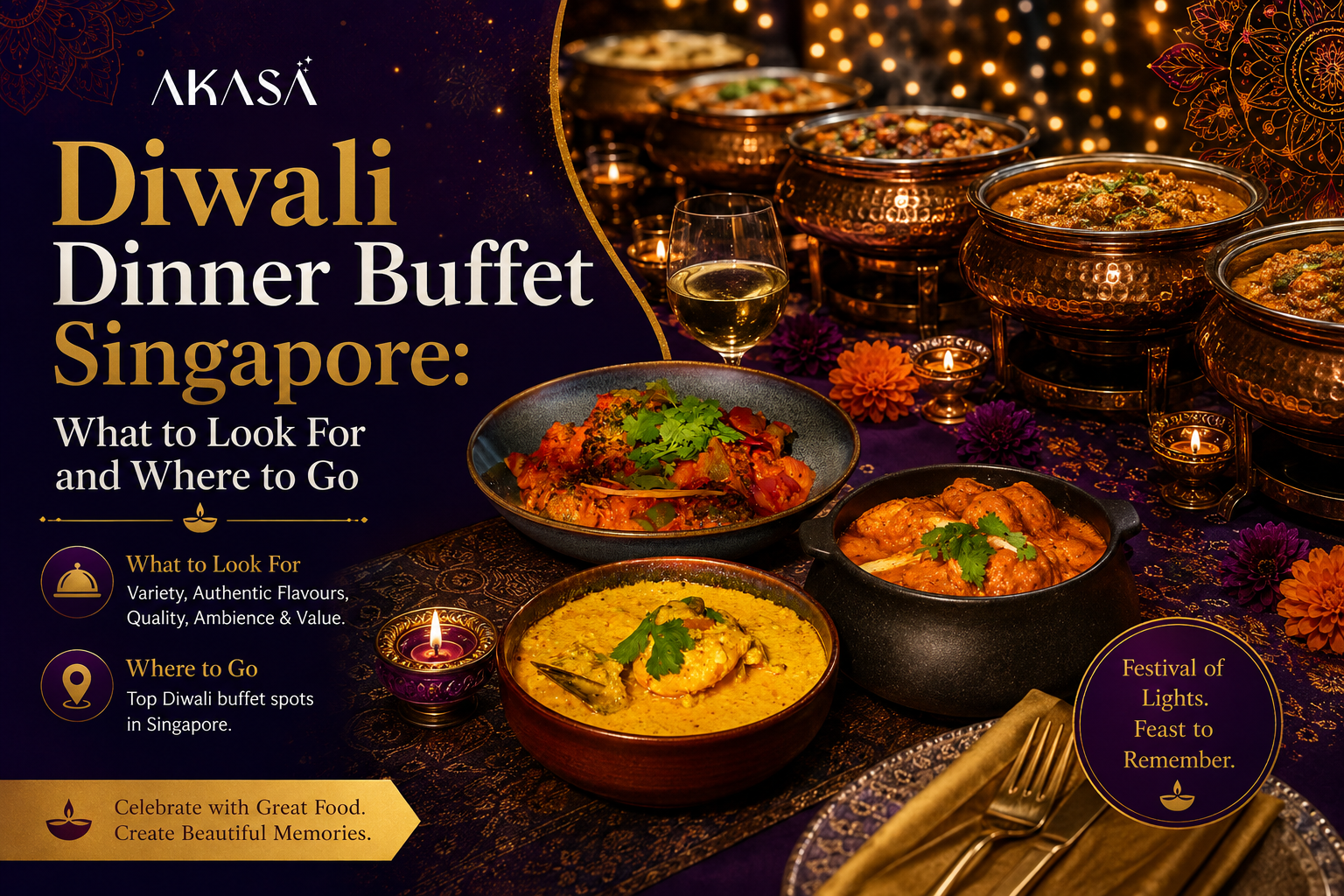
15. Festive Dinner — Diwali Is the Best One to Plan Around
Singapore has a packed festive calendar. Most restaurant festive menus are variations on the same idea. Diwali is the exception where an Indian restaurant festive dinner actually aligns culturally, culinarily, and experientially.
The food, the occasion, and the atmosphere all make sense together. If you’re going to plan one festive dinner ideas in Singapore this year at an Indian restaurant, make it Diwali.
16. Healthy dinner ideas in Singapore That Doesn’t Taste Healthy
The association between Indian food and heaviness is mostly about preparation style, not the food itself. Tandoor cooking is lean. Dal is protein-dense and genuinely nutritious. Vegetable sabzis cooked with turmeric, cumin, and ginger are good for you in ways that don’t require justification.
A dinner of dal, a vegetable dish, and roti is balanced, filling, and full of flavour. It’s worth noting that some of the most frequently eaten meals across India are also among the nutritionally solid ones.
17. Team dinner ideas in Singapore — The One That Actually Creates Some Energy
Team dinners in offices tend to default to a restaurant that’s convenient and inoffensive. Which usually means forgettable. The dinner gets done, people go home, and nobody really talks about it.
A better team dinner idea in Singapore has food that requires people to interact — sharing dishes, reaching across the table, making decisions together about what to order. Indian cuisine does this naturally. The format alone creates more energy than individual plated mains served in silence.
18. Late-Night Dinner Ideas in Singapore When You Have No Plan
Singapore has enough late-night dining options that not having a plan at 9:30pm isn’t a real problem. The CBD, Orchard, and Clarke Quay areas all have restaurants running kitchen service past 10pm.
The main trap is assuming a restaurant is open without checking. Call ahead or check Google — hours listed online are often the restaurant hours, not the kitchen hours. These are different things and matter when you’re hungry.
19. Waterfront dinner ideas in Singapore in Marina Bay
Marina Bay is one of those Singapore settings that justifies the effort of getting there. A few restaurants in the area combine genuinely good food with a view that makes the whole evening feel like more than a Tuesday dinner.
Do the research before you book here — a bad meal with a great view still leaves you with the memory of a bad meal.
20. Dinner for No Reason at All
Most dinners don’t need a category. Sometimes you’re just hungry and want something good. You don’t need a special occasion to book a table at a restaurant you’ve been meaning to try. You don’t need a group. You don’t need a reservation at a place with a two-month wait.
The best indian restaurant in Singapore for a regular weeknight dinner is one that makes you feel like coming back. That’s the real standard. Akasa earns it consistently — the food is good, the experience is comfortable, and you don’t leave with that slightly hollow feeling you get when a restaurant overcharged you for less than it promised.
Before You Go — Things Worth Knowing
Weekends at most decent Singapore restaurants fill up by 7:30pm. If you’re not booking, go early or go late. The 7–9pm window is the hardest time to walk in without waiting.
Prices on menus don’t include GST and service charge. Add about 20% to whatever you see on the page. Not a complaint, just maths worth doing before you sit down.
Weekday Set menus are almost always better value than ordering à la carte. Ask if there’s one before you open the main menu — a lot of restaurants don’t list it prominently.
Frequently Asked Questions
Sharing-plate formats work best. North Indian cuisine, Korean BBQ, or Middle Eastern mezze are all built around communal eating. Indian restaurants handle larger groups well because the food naturally goes in the middle of the table.
Yes — particularly if your clients haven’t had quality Indian food at a proper restaurant before. It’s memorable, the setting at a place like Akasa is appropriate for business, and the food creates conversation.
Hawker centres: $10–$18. Mid-range restaurants: $30–$50 per person with drinks. Fine dining or premium: $80–$150. Most options in this list sit in the middle bracket.
Depends on the occasion. CBD and Tanjong Pagar for after-work and business dinners. Dempsey and Holland Village for relaxed evenings. Orchard Road for accessibility and variety. Marina Bay for setting.
Tanjong Pagar and the surrounding CBD area probably wins this. You’ve got Indian, Japanese, Korean, Western, and local food all within a 10-minute walk of each other. It’s convenient if you’re coming from the office and still deciding what you want to eat on the way there.
Depends on the day and the restaurant. Weekday dinners before 7pm — walk-ins are usually fine at most places. Friday and Saturday after 7pm at any restaurant worth going to — book ahead. You won’t always need the reservation but you’ll definitely feel it when you do.
Start with a shared spread rather than ordering one dish for yourself. Get a curry, a dal, some bread, and a rice dish for the table. Indian food is meant to be eaten with combinations — a bit of this with a bit of that — not one dish in isolation. A good indian restaurant in Singapore will usually guide you if you tell them it’s your first proper sit-down Indian meal.
Indian restaurants handle this better than most. The menu split between vegetarian and non-vegetarian dishes is usually even, and both sides of the table eat well without one group compromising. It’s genuinely one of the easier cuisines to share across dietary preferences.
6:15 to 6:30pm is the window. Most dinner services start filling properly from 7pm onwards. If you get there slightly before the rush you’ll almost always get seated. Arrive at 7:30pm without a booking on a Saturday and you’re taking your chances.
Recent Posts
View More Articles